
Showing posts with label Research. Show all posts
Showing posts with label Research. Show all posts
Sunday, 11 November 2012

Title analysis
Memento (By Christopher Nolan) Opening titles

The actual title of the film (that comes before the other titles), is larger than the other titles but uses the same font and colour. However, the letters are more separate, taking up more space on the screen and creating a bigger difference between the main title and the other titles.

The titles fade in and out very simply and at a steady pace. Simplicity can be effective because it creates seriousness and leaves the viewer with less to expect.
What the opening sequence contains:
- Distributors – New Market and
Summit - Production company – Team Todd
- Film Supervisors
- Name of Film - Memento
- Names of stars and actors
- Casting Directors
- Music Supervisor
- Costume Designer
- Editor
- Production Designer
- Director of Photography
- Co-Producer
- Co-Executive Producers
- Producers
- Screenplay Supervisor
- Based on the story by…
- Director
Iconic sounds
Wierd Pychotic Laughing
Heavy breathing
Voice-overs
Rain (weather is always gloomy)
Enhanced sounds (detail is very important, so this genre usually makes all the minor sounds louder)
Heartbeat- used sometimes to increase tension
History of the Thriller genre (focusing on Psychological Thrillers)
The genre of thriller is used in literature, film and television programming with the use of suspense, tension and excitement as main elements. They heavily stimulate the viewer's moods making them feel anticipation, ultra-heightened expectation, uncertainty, surprise, anxiety and/or terror. The most common use of subgenre to thriller is mystery, crime and psychological thrillers, however there are also many other subgenres.
History in Literature
- The Little Red Riding Hood (1697) is an early example of a psycho-stalker thriller as an innocent girl is convinced by a wolf to take the long path while he reaches her grandma's house and eats (or hides) her. The ideas of the wolf's stalking and manipulation are conventions of the psychological thriller genre.
- The Count Of Monte Cristo (1844) is a swashbuckling revenge thriller in which the protagonist is betrayed by his friend and is sent to a prison in southern France from which he later escapes and seeks revenge. The story uses conventions such as revenge, power and betrayal which relate to the thriller genre.
- Heart Of Darkness (1903) is a first person within a first person about a man who travels the who travels up the Congo River in search of an enigmatic Belgian trader. Layer by layer, the atrocities of the human soul and man's inhumanity to man are peeled away. This could be seen nowadays as a psychological thriller because of the psychotic theme and conventions it contains.
- The Bourne Identity (1980) is one of the first psycho thrillers to be written in a modern stlye. It tells the story of a man with gun shot wounds who is found floating in the Mediterranean Sea, and when taken to shore he wakes up with Amnesia. In look for his identity, the conventions of ambiguity, and the unknown are shown quite clearly. These are main themes of the psycho thriller genre.
History in film
1920s-1930s- Aflred Hitchcock's first thriller was the third silent movie The Lodger (1926) which was a Jack the Ripper story. This film was a psycho thriller because it dealt with a psycopath murderer and so had a typical story line of this genre. Hitchcock also produced thrillers such as Blackmail (1929)- his first sound film, Murder!, Number Seventeen,The Man Who New Too Much. These were all suspense films.
- The chilling german film M (1931) directed by Fritz Lang, told the story of a crminial deviant who preyed on children.
- Other British directors, such as Walter Forde, Victor Saville, George A. Cooper, and even the young Michael Powell made more thrillers in the same period; Forde made nine, Vorhaus seven between 1932 and 1935.
- Hitchcok continued to perfect his recognition in the suspense-thriller genre with films such as Foreign Correspondent (1940) and the oscar winning Rebecca (1940) about an unusual romance between a young woman and an emotionally distant rich widower.
- Gaslight (19440 was a psychological thriller directed by George Cukor that told the story of a husband that plotted to turn his wife insane in order to aquire her inheritance.
- HItchcock then added colour to his thrillers,when he prodcued classic such as: Strangers on a train (1951), Dial M for Murder, To cath a thiefl, Vertigo, and North by Northwest.
- Niagara (1953) by Henry Hathaway starred Marylin Monroe and tells the story of a woman who plotts to kill her husband.
- Spy films were also quite popular in this decade.
- After Hitchcocks classics in the 50s, he released a shocking and engrossing thriller called Psycho (1960) about a loner mother-fixated motel owner and taxidermist. This was an iconic film because of the famous shower scene in which a woman is stabbed brutally. This scene has been re-enacted in many modern films and it has become an icon of the thriller genre.
- Inspired by Psycho, Michael Powell produced the film Peeping Tom about a psychopath cameraman.
- Roman Polanski's first film in English, the frightening and surrealistic Repulsion (1965) – with Catherine Deneuve as a young woman who goes increasingly mad.
- In this decade, thrillers started to get more vivid and Hitcocks Frenzy (1972) was given an R rating because of the explicit strangulation scene.
- Brian De Palma usually had themes of guilt, voyeurism (obssession with spying on others having sex), paranoia and obsession in his films. Similar plot elements include killing off a main character early on, switching points of view, and dream-like sequences. His films include, the psycho-thriller Sisters (1973), a film about dual personalities, Obsession (1976) which was somewhat inspired by Vertigo, Dressed to Kill (1980), and the assassination thriller Blow Out (1981).
- The decade ended with Phillip Noyce's Dead Calm (1989), a psychological thriller with Nicole Kidman, who must fight for her life on a yacht against a crazed castaway.This film showed elements of obssession and trapped protagonists that inspired many thrillers in the 90s.
- The decade started with Rob Reiner's Misery (1990) which tells the story of a psycho fan.
- The theme of obsession was becoming popular and many films featured it: Unlawful Entry (1992), Single White Female (1992), Malice (1993)- starring Nicole Kidman, and The Talented Mr. Ripley (1999)
- Another emerging theme of thrillers was the FBI/agent hunting a serial killer and the most famous example of this was the picture winning, The Silence Of the Lambs (1991) by Jonathan Demme. This was classified as a crime thriller but it also merged into the psycho thriller subgenre as it dealt with a psychological issues. David Fincher's Se7en (1995) is another example of a crime thriller that was famous.
- Recent thrillers have a lot of influence from the horror genre and tend to use more gore. But some of the best work contains some of the original conventions that made thrillers so captivating.
Tuesday, 6 November 2012
Opening sequence of 'The Silence of the Lambs'
Cinematography-
- The scene starts with a tracking shot following the main subject, which is the girl running. As she runs, the scene is fast paced as it mirrors her fast breathing and adrenaline rush.
- We first have a big close-up of her face and then it zooms out into a medium shot and a very long shot as she runs onwards through the assault course.
- When the FBI approaches her and they have a conversation, there is an over the shoulder shot.
- There is a downward tilt on a close- up shot of a tree with presumably important words hanging off it. The words ‘hurt’, ‘agony’, ‘pain’, ‘love-it’, have negative connotations and could foreshadow future events.
- We later have a very long shot of the building which the protagonist is going into.
- The camera zooms into the building as she enters it and then jump cuts into her walking down some stairs.
- There is then a trcking shot that follows the protagonist as she walks in and out of rooms as she walks fastly with a purpose (increasing the pace of the camera.)
- A mediums shot follows the conversation of the protagonist and another FBI.

- The beginning has non-diagetic music.The use of orchestral instruments gives the music a dramatic feel that connotes a sense of unease and worry. It fades out as she speaks and then starts again when she starts running once more towards the building.
- There is the diagetic sound of speech when the FBI tells her someone wants to speak to her in the building.
- As she runs you can hear the diagetic sounds of her feet running on the soil track and the russtling of leaves to set the atmosphere of the woods.
- Later there is the diagetic sound of speech and people moving and talking as she walks into the building and speaks to another member of the FBI.
- The beginning is set in the woods, so there are many trees around the track the girl is running. Connoting isolation and danger.
- The viewer is made aware of the posts on the tree which means they might link to something further on in the movie.
- When she enters the building we see guns and police officers. These connote law and order.
- There is a shot showing photographs and news paper clippings of murderer called "Buffalo Bill", meaning there is already a villain on the loose and danger is connoted.
- The titles are white, simple and relatively small. They go into the film where they get larger as well as black and the capitalisation could emphasise the theme of urgency that goes on throughout the film.
- they fade in and fade out very simply.
- There are many jump cuts which quicken the pace of the movie and mirroring the tempo of the protagonist which is running everywhere.
- From the first few minutes we gather that the protagonist is an FBI that is called in for a mission of some kind. This idea of police is a generic convention of psychological thrillers because it depicts that there is someone out of place in society that is doing something bad.
- As she enters one of the rooms, she sees pictures on the wall of a murderer which suggest that there is a criminal that this protagonist is going to have to find.
- As she speaks to the officer, he sets her an assignment that is not clear to the audience at this point and creates ambiguity which is another theme within the psychological thriller genre.
- The first part of the scene is filmed in some dimly lit woods, with relate to the genre because the low lighting is convention of a thriller.
- The fact that she is running through the woods makes us wonder whether she is running from danger or not, however we later realise that she was training.
- The woods is an isolated place and this, again, is a convention of the genre we are studying.
- It is misty and early in the morning creating an eerie feel that links to the genre.
- The viewer later finds out that she is running an assault course which is not very common of women and so is out of the ordinary. Out of the ordinary is also a convention of psychological thrillers.
- The masculinity is continued in the building with the blue walls and the guns.
- Inside the building the atmosphere connotes law and order, with serious colours and the presence of uniformed people.
- Loneliness
- Ambiguity
- Law and order
- criminality
- Masculinity
- eeriness
- unease
(these are all themes that link to the genre)
- The first character we see and follow is the girl and so we immediately assume that she is the protagonist as the camera follows her throughout the whole beginning sequence. She sticks out like a sore thumb in the corridors of the FBI base because she is the small female among the large men.
- Unlike normal portrayals of females, she is sweaty unglamorous, and a bit masculine.
- The FBIs address her with respect suggesting that she is quite respected in her job and she is successful.
- The fact that she is a female makes her more vulnerable and breaks the normal view of a male cop chasing the 'bad guy'.
- This strange choice of protagonist and hero links to the genre because it leaves the viewer with nothing to expect as the situation is out of the ordinary.
Monday, 5 November 2012
Audience Research
As a group we conducted a questionnaire that we would hand out to people of 16+ helped us inquire into what genre we should create our opening sequence of. From the results we gathered that people enjoy watching Thriller films and films that cause them to get an adrenaline rush. The results are as follow:
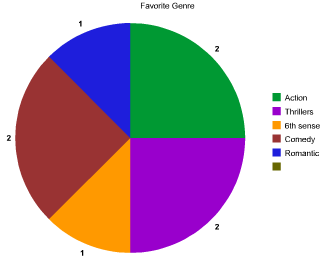 |
| This is a pie chart looking at who completed our questionnaire and their favourite genre of films. It came to conclude that thriller films came on top and this gives us a clear indication as a group that we should base our film around the thriller genre and conventions of the genre. |
 |
| From this pie chart about 'fear factor' we can conclude that our audience get more scared from seeing and watching real life scenarios and adrenaline rushes. This helps us by suggesting conventions and elements to have in our opening sequence. |
 |
| This pie chart looks at 'What do you look for in a good film' Strong storyline was the one that came out on top which suggests that we should ensure that we have a very strong storyline that can grab and and entice the audience. Good acting was the second most important thing which indicates that we need to make sure we have strong actors with confidence and that can own the stage. |
 |
| Silence of the Lambs proved to be a popular film amongst our Psycho-Thriller lovers and we as a group can look into this film and analyse the conventions of the film and use those on our opening sequence. |
Subscribe to:
Posts (Atom)